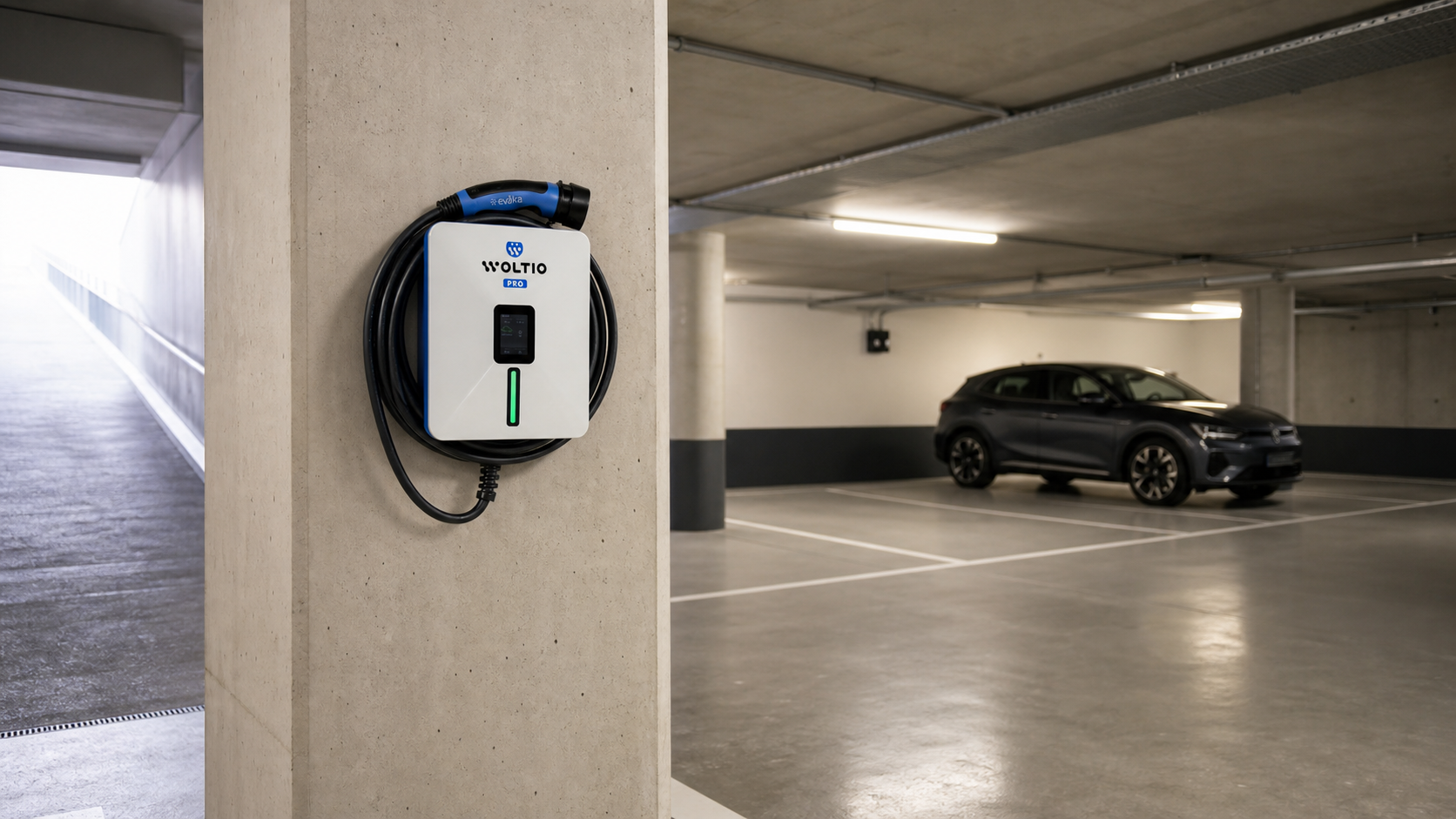
Installing charging points in a shared garage often begins with an individual need: a resident buys an electric car and wants to charge it in their parking space. However, as more residents take the same step, the infrastructure must support several simultaneous charging sessions without exceeding the available power.
This is where the load management system comes into play. This system coordinates the charging points connected to a shared installation and distributes energy so that vehicles can charge in an orderly manner. It does not generate more power or speed up charging on its own; it makes better use of the existing capacity.
Having this management in place from the initial planning stage helps prevent overloads and oversized investments. It also prepares the parking garage to accommodate new users.
A load management system is a control system that monitors the available power and regulates how much energy each connected charger receives. To do this, it measures the consumption of the installation or charging circuit and automatically adjusts the current of the equipment.
In a shared parking garage, it can coordinate several charging points at once. If only one vehicle is charging, it can receive more power within the configured limits. If several cars are connected, the system distributes capacity among them to keep total consumption below the maximum established in the electrical design.
The system may include metering, communication and control equipment. Its configuration will depend on the electrical layout, the number of parking spaces and the available power.
A building’s power supply is not unlimited. Lifts, lighting, pumps, automatic doors and other shared services also consume electricity. A charging installation must be designed taking these uses into account, as well as the actual capacity that can be allocated to vehicles.
The load management system continuously compares consumption with the limit defined for charging. When demand is low, it can allocate more energy to connected vehicles. If the number of cars or the building’s consumption increases, it temporarily reduces the power of one or more charging points.
Charging does not necessarily have to stop: it can continue at a lower speed until capacity becomes available again. This allows the system to adapt to a situation that changes throughout the night without requiring anyone to intervene.
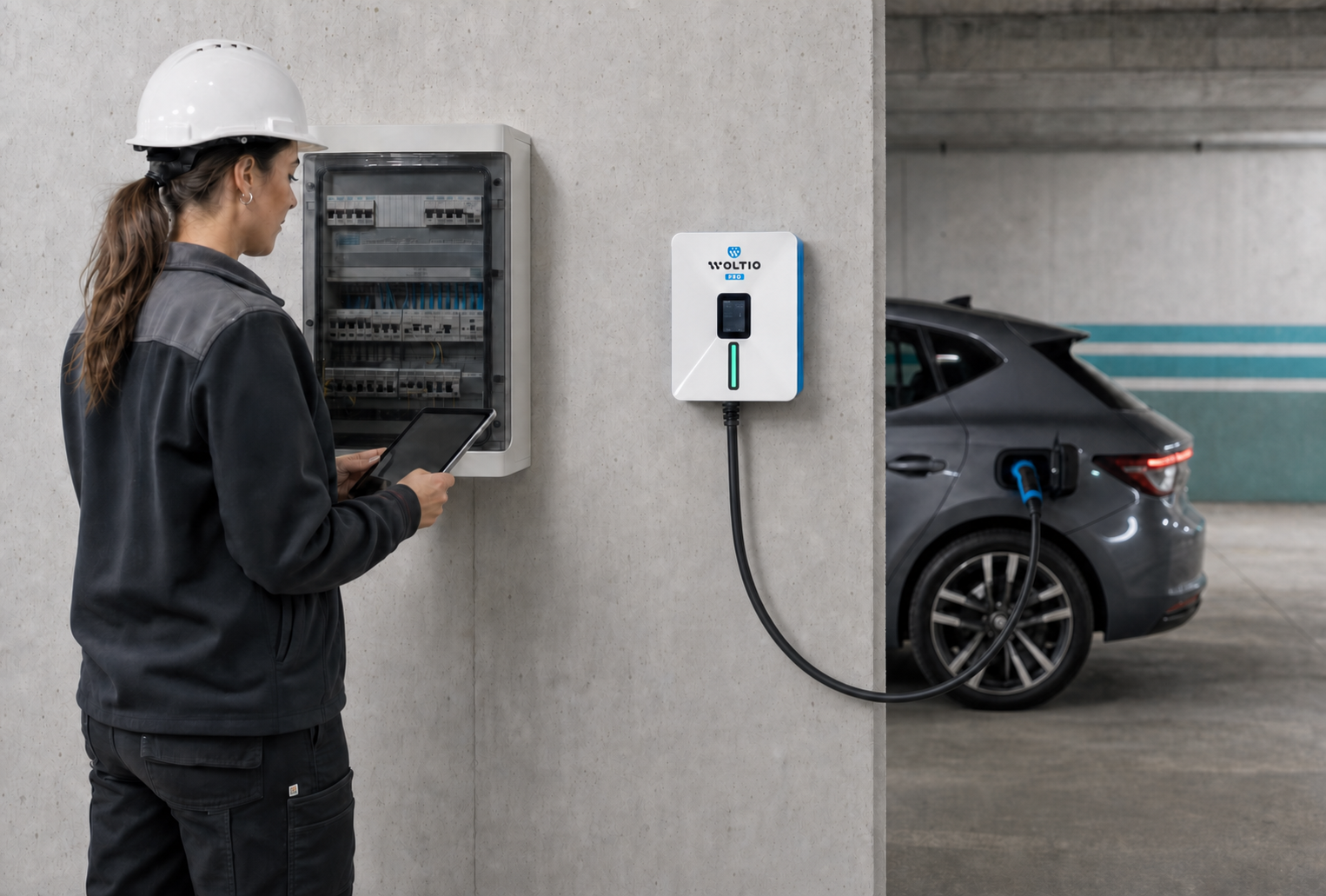
The main advantage is operational safety: by controlling combined demand, the risk of exceeding the limit planned for the charging circuit is reduced. ITC-BT-52 specifically provides for systems capable of measuring current and reducing charging intensity when necessary to prevent overloads.
It also makes better use of the infrastructure. Sizing an installation on the assumption that all cars will always charge at maximum power may require contracting or installing capacity that will barely be used. Coordinated management adapts consumption to actual demand and enables a more proportionate investment.
Another benefit is scalability. A residential community may start with few users, but it must anticipate that more will join. Having suitable conduits, protection systems, communications and a management system prevents each new connection from being handled as an isolated case and helps maintain an orderly shared solution.
Finally, distribution rules are applied automatically. If individual consumption needs to be identified, suitable metering and billing or compensation systems must be incorporated.
The principle is similar, but the context changes. In a home, load balancing usually coordinates a single charger with household consumption so that both remain within the contracted power limit. In a shared parking garage, management may need to coordinate numerous charging points, users and metering requirements across a shared infrastructure.
If you are looking for a solution linked to a single home or a parking space connected to your individual supply, you can explore our home electric car chargers.
What to review before choosing a load management system
The first step is to understand the starting point: how many vehicles will charge now, how many parking spaces could be added in the coming years, and how much power can be allocated to charging. With this information, a qualified professional will be able to define the electrical layout and operating limit.
You should also check communication between chargers and the system, decide how consumption will be measured, and agree on the distribution criteria. The possibility of expanding the installation should be part of the decision.
Administrative and regulatory aspects should not be left until the end either. Before carrying out the installation, review the requirements and regulations for installing charging points in residential communities and request a technical study tailored to the building.
The load management system turns a set of independent chargers into a coordinated installation. Its aim is not for every car to receive maximum power at the same time, but for the available energy to be distributed safely, efficiently and in line with the actual needs of the parking garage.
This is why it should be planned before the number of electric vehicles increases. A properly sized system makes it possible to start with the parking spaces needed today and expand tomorrow in a more orderly way, while keeping electrical safety, equipment compatibility and user experience in mind.