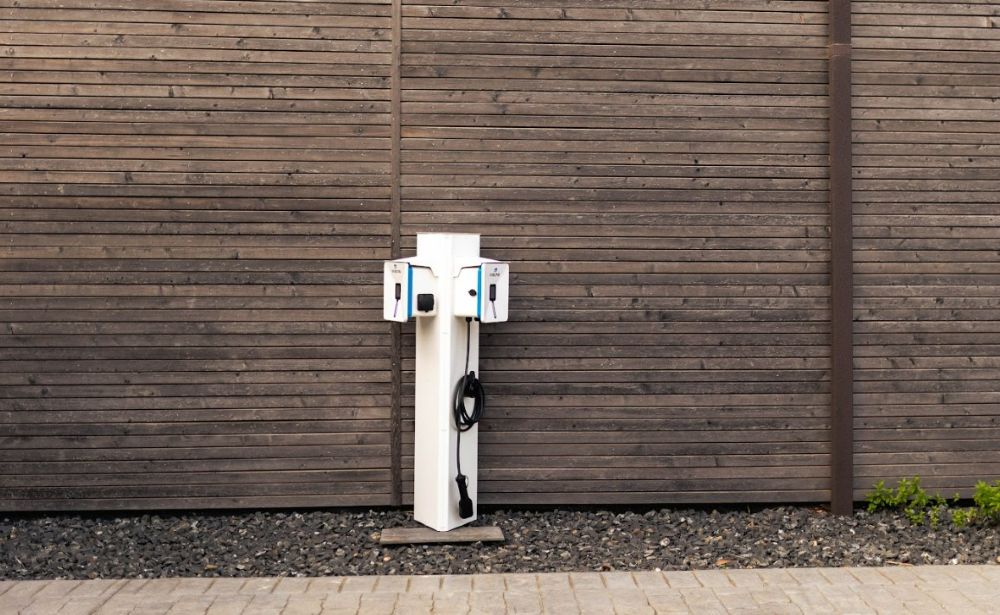
Installing an EV charging point for businesses has become a real necessity because more and more employees drive electric vehicles or plug-in hybrids. Customers, suppliers, and partners do too, so having charging infrastructure is no longer just a matter of sustainability, but also of functionality.
But how many charging points should the company parking lot have? There is no standard figure, truth be told, since it depends on the size of the parking lot, the users’ profile, and the daily use that will be made of the chargers. But it’s clear that it’s important to size the potential charger demand correctly to optimize the investment and avoid saturation problems in the future.
Before making any estimate, it’s important to analyze the company’s specific situation. A fixed-schedule office is not the same as an industrial facility with multiple shifts. Nor is a company with its own fleet the same as one that only wants to offer the service to employees.
The first aspect to define is the corporate fleet. If the company has its own electric vehicles, these will have priority when using the EV charging point for businesses. You need to know how many EVs there are, how many kilometers they drive per day, and how long they remain parked in the lot. A sales rep who travels a lot will need to charge almost daily. By contrast, an occasional-use vehicle can alternate its charging schedule.
The second key point is employees. It’s a good idea to estimate how many workers already use an EV and how many could do so in the short or medium term. This information can be obtained through internal surveys. It’s also useful to analyze market trends in the area. The number of EVs continues to grow, so it’s advisable not to think only about the current situation, but also the near future.
The third element to consider is visitors and customers. In many companies, offering an EV charging point for businesses improves corporate image. In addition, it can be convenient for those who come for meetings or provide services at the facilities. Not everyone will need to charge their vehicle, but it is advisable to plan for some availability if visitor volume is high.
Lastly, it’s important to analyze work shifts. In companies with rotating shifts, the same charger can be used by different vehicles throughout the day. This helps optimize the infrastructure. If, on the other hand, cars remain parked for the entire workday without moving, turnover will be lower and it may be necessary to install more points.
Defining these four factors provides a solid foundation for calculating how many EV charging points for businesses are truly necessary.

Once the usage profiles are defined, the next step is to translate that information into real demand. This is where many companies make mistakes. It’s not about counting all electric vehicles linked to the organization. What matters is calculating how many will need to charge at the same time.
Not all drivers charge daily at work. Many do it at home and use the EV charging point for businesses as occasional support. That’s why estimating simultaneous demand is more useful than the total number of EVs.
For example, if a company has 15 employees with an EV, that doesn’t mean it needs 15 chargers. It may be that only some need to charge on a given day. Analyzing usage frequency is essential to fine-tune the calculation.
In addition to the number of vehicles, you must estimate how much energy they will need. Not all cars consume the same. It depends on kilometers driven and battery capacity. An employee who lives nearby and drives few kilometers may need a partial charge. By contrast, a worker who makes long trips will need a greater energy input.
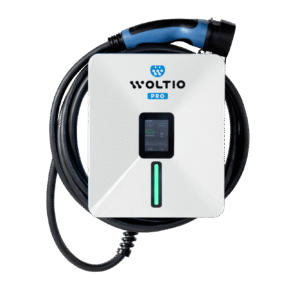
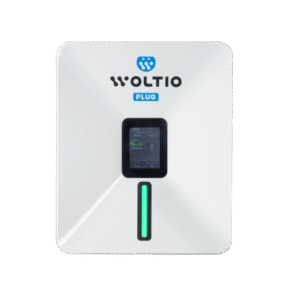
The charger’s power rating also matters. EV chargers for businesses such as WOLTIO PLUG, which allows you to adapt power to the installation’s needs, are an excellent addition.
It is a universal, 100% smart model compatible with all vehicles that use the European Type 2 standard to make it easier to deploy charging points without worrying about compatibility.
In addition, the WOLTIO app for iOS and Android lets you control the main charging parameters from your phone, simplifying energy management in business environments.
With the previous data, you can apply a practical method to determine the right number of chargers.
The first step is to calculate peak simultaneous demand. That is, estimate how many vehicles might need to charge at the same time on a busiest day. This should include fleet vehicles that charge regularly, employees who are likely to use the service, and a small allowance for visitors.
The second step is to analyze the average time vehicles stay in the parking lot. If vehicles remain parked for eight hours, an charging point can cover a car’s full need in one workday. However, if the average stay is three or four hours, the same charger could be used by two vehicles in the same day. Higher turnover reduces the total number of EV charging points for businesses needed to meet demand.
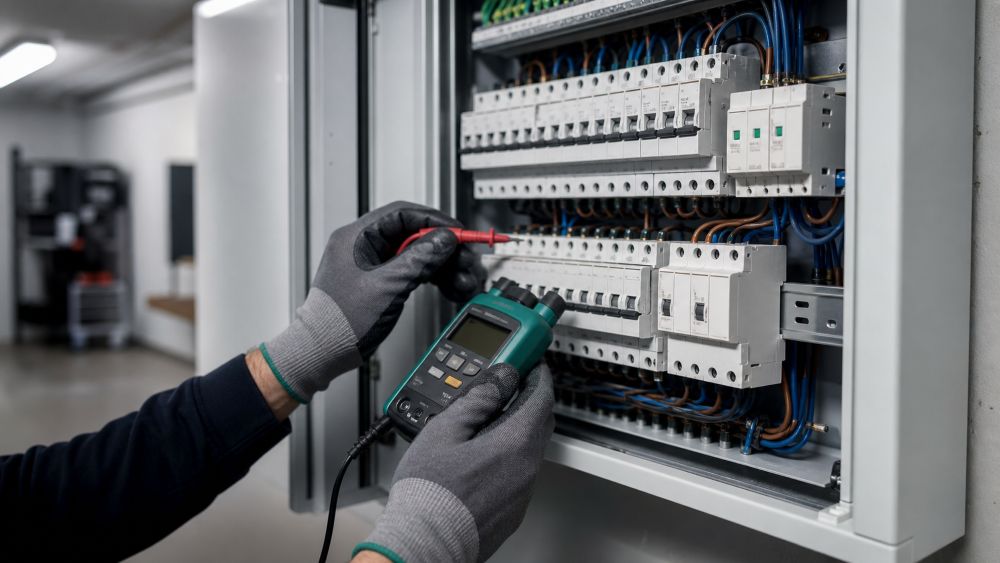
The third step is to review the power available in the electrical installation. This is key. If contracted power is limited, it may be more efficient to install several chargers with dynamic load management rather than a few high-power chargers. Smart management makes it possible to distribute available energy among connected vehicles, avoiding overloads and optimizing consumption.
The fourth step is to plan for growth. The number of EVs will continue to increase. Therefore, it is advisable to prepare the infrastructure for future expansions. This may involve planning conduits, space in the electrical panel, and strategic layout in the parking lot. This way, expanding EV charging points for businesses will be simpler and more cost-effective.
One of the most common mistakes is oversizing the installation as a precaution. Some companies install a large number of chargers from the start without real usage data. This is a significant investment that can take time to pay off.
Another frequent mistake is not considering energy management. Installing multiple EV charging points for businesses without studying the available power can create technical issues. Without smart management, the system can cause consumption peaks that make it necessary to increase contracted power.
It is also common not to differentiate between user types. Fleet vehicles may have priority over employees or visitors. Establishing clear usage criteria improves system efficiency and avoids conflicts.