More and more homes are combining a photovoltaic installation with an electric car. This combination allows you to reduce energy costs and take advantage of a greater part of the electricity generated by solar panels. However, to obtain maximum performance it is not enough to have both systems. It is also important to intelligently manage when and how the vehicle is recharged.
In this sense, a charger compatible with the management of photovoltaic surpluses helps to use the energy available at all times, preventing a part of the solar production from being dumped into the grid without being used. In this way, it is possible to increase the level of self-consumption and further reduce dependence on the electrical grid.
Next, we will tell you how photovoltaic surpluses work, how to coordinate solar production with home consumption and what solutions we offer at WOLTIO to get the most out of a self-consumption installation.
You may be interested in:
Charge your electric car with solar panels
Photovoltaic surpluses are the energy produced by solar panels and that is not immediately consumed in the home. When this happens, that electricity can be injected into the electrical grid or used for other uses, such as recharging the electric car.
In many homes, the highest solar production coincides with the central hours of the day. However, during this period there is usually reduced domestic consumption because a large part of the family members are away from home. As a consequence, a significant part of the energy generated is not used directly.
This is where a smart charger comes into play. If the vehicle is connected during those hours, the system can use the surplus to power the car’s battery before turning to electricity from the grid.
This operation makes it possible to increase the percentage of self-consumption and take advantage of energy that, otherwise, could not be used within the home itself.
For the use of solar energy to be truly efficient, it is necessary to balance three elements: the production of photovoltaic panels, home consumption and the energy demand of the electric vehicle.
Intelligent management ofelectric car chargers at home It allows the charging power to be continuously adapted according to the energy available at any given moment.
During the hours of greatest solar radiation, the photovoltaic installation reaches its maximum generating capacity. If the home’s consumption is less than that production, the excess energy can be used to charge the car.
Chargers compatible with photovoltaic management systems automatically adjust the charging power to take advantage of these surpluses without exceeding the available energy. In this way, the vehicle is recharged using primarily the electricity generated by the solar panels.
This process is carried out dynamically. If home consumption increases because several appliances are turned on, the charger can reduce the power allocated to the car to avoid importing unnecessary energy from the grid.
Not all days have the same solar production conditions. The presence of clouds, the season of the year or greater domestic consumption can reduce the amount of surplus available.
In these situations, the system can automatically supplement solar energy with electricity from the grid to keep the vehicle recharged when necessary.
This allows you to combine energy efficiency and comfort. The user decides whether to prioritize only solar energy or allow the charger to supplement the necessary power using the electrical grid when surpluses are insufficient.
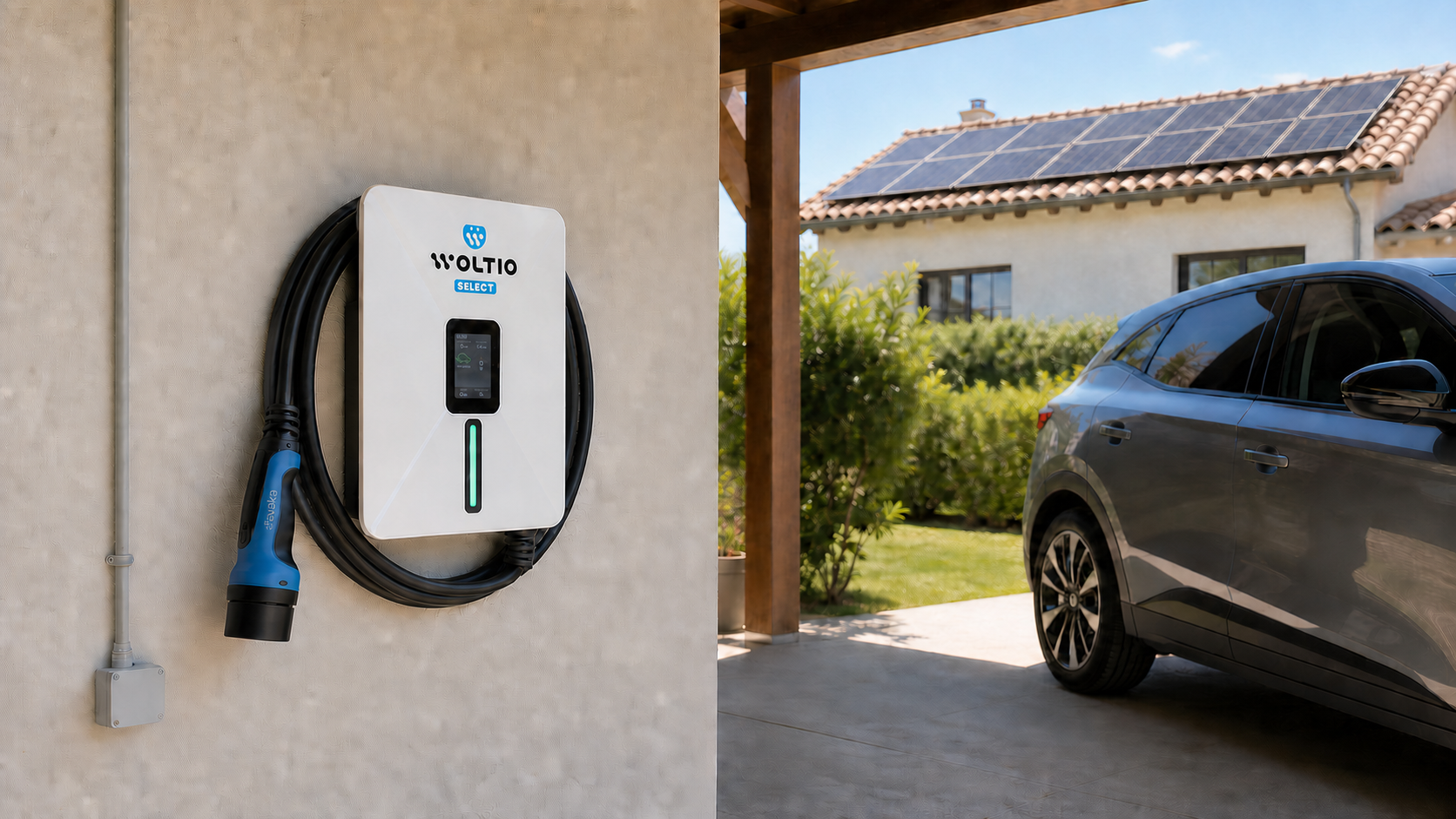
To correctly manage photovoltaic energy, it is not only necessary to have solar panels and a smart charger. It is also important to have the appropriate accessories so that the system knows at all times how much energy the installation produces and what the real consumption of the home is.
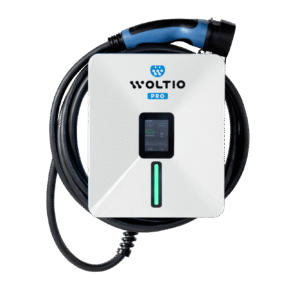
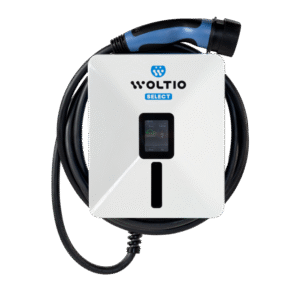
The WOLTIO SELECT and WOLTIO PRO chargers can be complemented with specific kits that allow managing photovoltaic surpluses and expanding the charging control options.
The first step consists of monitoring both the energy generated by the photovoltaic installation and the instantaneous consumption of the home.
Using this information, the system can accurately calculate how much surplus is available at any given time and adjust the vehicle’s charging power accordingly.
This continuous monitoring prevents overloads in the installation and optimizes the use of the electricity produced by the solar panels.
The photovoltaic kit allows the charger to automatically adapt the charging power depending on the available solar energy.
When there are surpluses, the system increases the power allocated to the vehicle. If solar production decreases or home consumption increases, the charging power is automatically reduced to maintain energy balance.
This continuous adjustment is carried out without the need for intervention by the user, favoring greater use of self-consumption and reducing the use of electricity from the network.
This is a particularly interesting solution for those who want the majority of the energy used to charge the car to come directly from their photovoltaic installation.
For those looking for an even more complete solution, at WOLTIO we have thedual kit.
This accessory combines the photovoltaic surplus management and remote connectivity functions in a single module. Thus, in addition to optimizing recharging using the available solar energy, it allows you to control the charger through the WOLTIO application for iOS and Android.
From the app it is possible to check the charging status, start or stop sessions, schedule schedules and monitor different charger parameters from anywhere.
By integrating both functionalities in a single device, the dual kit simplifies installation and offers a very complete solution for homes with photovoltaic self-consumption.
Having solar panels does not in itself guarantee that all the energy produced will be used efficiently. There are some common errors that can significantly reduce the percentage of self-consumption.
One of the most common is to always charge the vehicle at night. Although in some cases it may be interesting due to electricity rates, this practice prevents the use of the energy generated during the hours of greatest solar production.
Another common mistake is not adapting the charging power to the available energy. If the charger always operates at a fixed power, it may need to import electricity from the grid even when there is photovoltaic production, thus reducing the use of surpluses.
It is also common to install solar panels without incorporating a system capable of measuring the home’s consumption. Without this information it is impossible to know precisely how much energy can be allocated to recharging the vehicle without affecting the rest of domestic consumption.
Finally, it is a good idea to periodically review the system configuration and use the available programming options. Organizing the recharge to coincide with the hours of greatest solar production allows for greater performance from the photovoltaic installation.