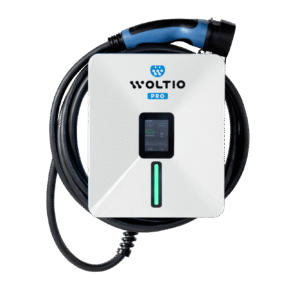
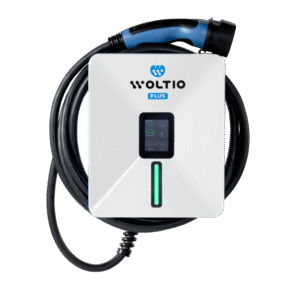
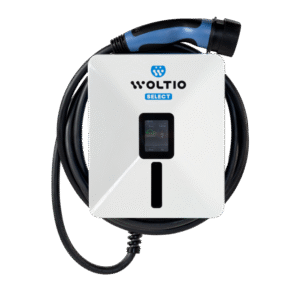
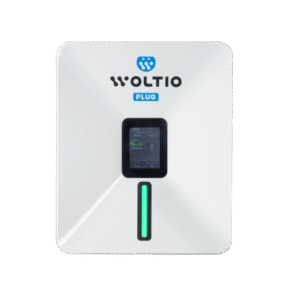
Users of a private charger for their electric car can choose between a cable integrated into their charging station or a socket type plug.
If you are not familiar with how these types of chargers work, you may not know the pros and cons of both types of connection, so let’s clear up any doubts you may have about chargers with integrated cables and those with socker types.
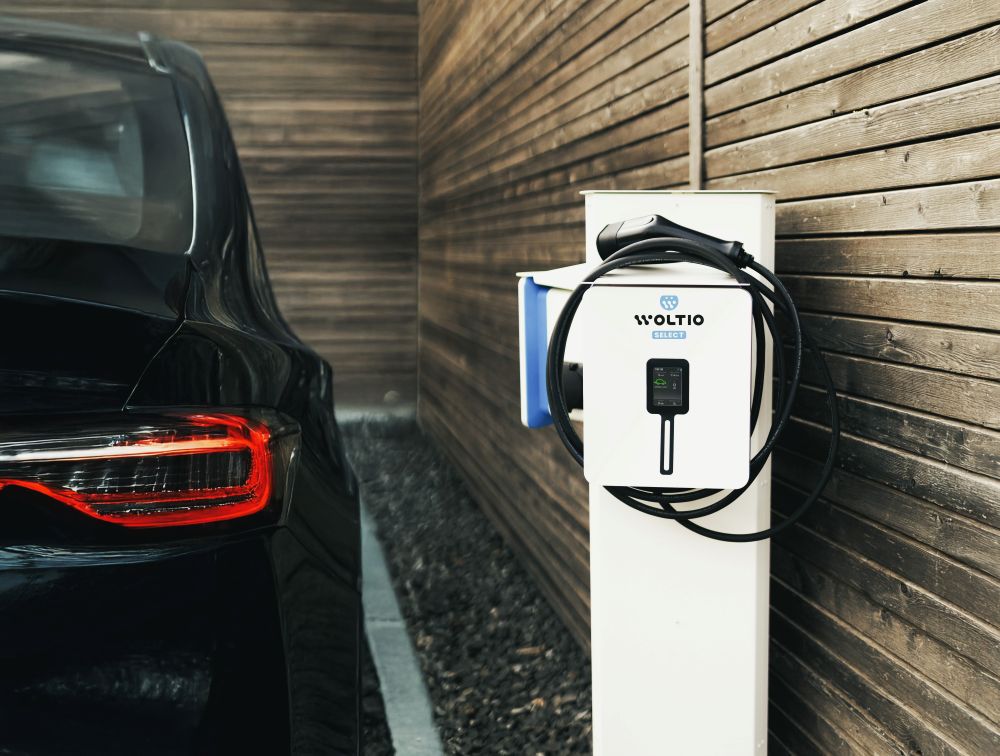
A charger with an integrated cable is a charging device for electric cars that includes a cable permanently attached to the device itself.
This means that the user does not have to connect any additional cables each time they arrive at the charging point. They only need to unroll the cable, connect it to the vehicle, and select the charging parameters.
This is a practical solution for those looking for convenience and speed. As it is always available, the cable reduces preparation time and avoids dependence on the car’s portable cable. In addition, its design usually includes supports that keep the cable tidy and protected when not in use, which helps to prolong its useful life.
This type of charger also stands out for its ease of use for users with less experience in electric mobility. Professional installation leaves the system ready to operate without the need for additional accessories.
On a day-to-day basis, simply connect the vehicle to start the process, either using the charger’s manual settings or a mobile application such as the WOLTIO app, which allows you to adjust parameters such as power or schedule charging times when the equipment is compatible.
Among the most notable advantages are convenience, fast charging start-up, and reduced wear and tear on the car’s own cable. As a disadvantage, the integrated cable may limit the available length, so it is advisable to choose a model with the appropriate length for the space where it will be installed.
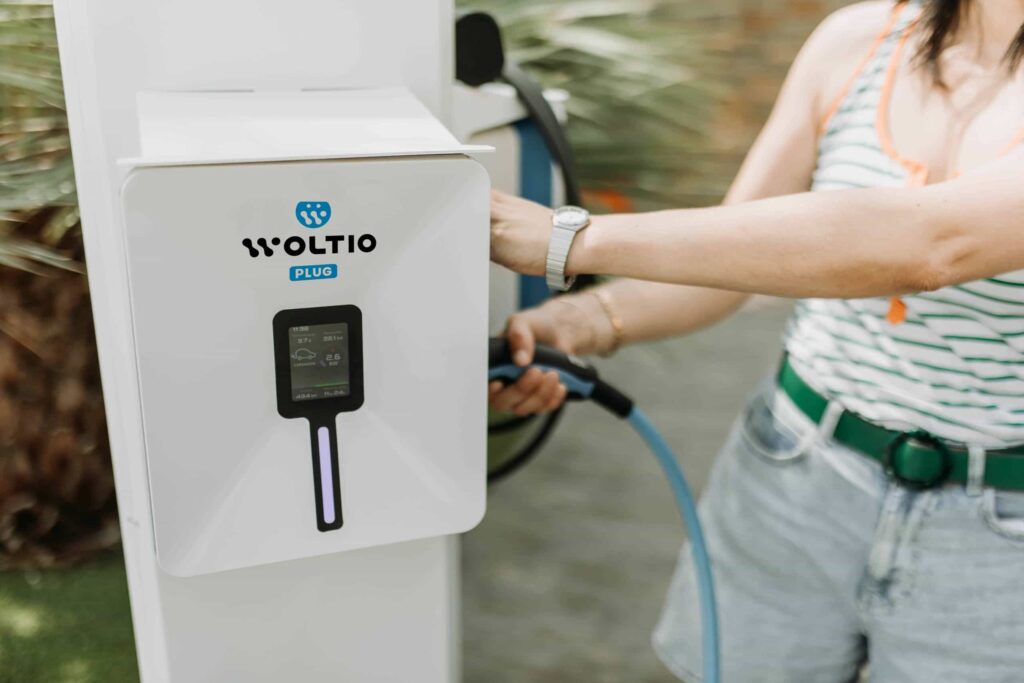
A socket-type outlet is a charging point that includes only the connection base, without any built-in cable. The user must have their own charging cable to connect the vehicle to the supply point. This cable is usually the one that comes standard with the car, although it can also be purchased or replaced with another one if necessary.
The main feature of a socket connection, such as the one included in the WOLTIO PLUG model, is its flexibility. As it does not incorporate a cable, the user can use cables of different lengths or easily replace them in case of wear and tear. This allows it to adapt to different parking positions or to various vehicles with different requirements.
However, its use requires some additional accessories. A type 2 cable is needed for cars with a European connector and, depending on the vehicle model, it may be advisable to have more than one cable to cover different situations. It is also important to have a place to store the cable when not in use, either in the trunk or on wall brackets.
The socket type requires a preliminary step each time you want to charge: take out the cable, connect it to the outlet, plug it into the car, and then put it away. Therefore, it is a more versatile system, but also somewhat less immediate than the charger with an integrated cable.
There are several differences to consider when choosing between a charger with an integrated cable and a socket-type charger. One of the main differences is convenience. Chargers with integrated cables allow you to start charging quickly, as the cable is always ready. Socket-type chargers, on the other hand, require you to connect and disconnect the cable each time you use them.
Another important difference is versatility. The socket type allows you to easily change cables, which is useful in places where different vehicles are charged or when you need to adapt the cable length to different situations. Chargers with integrated cables do not offer this flexibility, as the cable is part of the design of the equipment.
In terms of maintenance, the integrated cable is usually better protected from damage, as it is stored in its specific holder. With the socket, the cable depends on the care taken by the user in its daily use. However, replacing it in case of damage is simple.
There are also differences in space management. The cable charger allows for a tidier installation in places where the same vehicle is always charged. On the other hand, the socker type may be more suitable for spaces with multiple users, as it prevents the cable from being exposed or damaged by intensive use.
What is clear is that both options are compatible with single-phase or three-phase installations and allow for safe energy management.
Choosing between a charger with an integrated cable or a socket requires analyzing the type of use, charging frequency, number of vehicles, and available space. Each solution offers specific advantages that may be better suited to some situations than others.
For a private home, especially when only one electric car is being charged, a charger with an integrated cable is usually the most convenient option. The user does not have to take out the cable each time, the process is faster, and the cable remains protected and tidy. It also keeps the installation visually clean.
It is also suitable for those looking for intuitive use. The cable is always in the same place and the charging experience is simple. This is especially useful when looking for a charging point that any member of the family can use without complications.
On the other hand, the socket type plug can be useful in cases where the garage has limited space or when you need to change cables depending on where you park. For those who travel a lot and always carry the cable in the trunk, it can be practical to use the same cable both at home and away.
However, if the home has a fixed parking space and the charging routine is always the same, the charger with an integrated cable usually offers greater convenience in the long term.
In community parking lots, companies, or second homes, the needs are different. In these environments, there are usually several users or several vehicles that can use the same charging point. Here, the socket-type outlet may be more suitable because of its versatility. Each user can use their own cable and avoid wear and tear on the common cable.
In companies, the socker type facilitates rotating use between cars from different fleets or employee vehicles. It also simplifies maintenance, because if a cable deteriorates, it is not necessary to intervene in the charger itself, only to replace the affected cable.
In second homes, where charging is less frequent, a socker type may be enough, as the daily convenience that can be decisive in the main residence is not required. The user can leave the cable stored away and use it only when visiting the property.
However, if the second home is used frequently or you want to ensure a smooth and convenient experience similar to that of your main home, a charger with an integrated cable may also be a good choice.