Charging infrastructure for electric vehicles has evolved significantly in recent years. Today, aspects such as connectivity, remote monitoring, and compatibility with different management platforms are becoming increasingly important, which is why the OCPP protocol has become a key standard within the sector.
When looking for smart chargers for electric and plug-in hybrid cars, it is common to find references to this protocol, but many people still do not know exactly what it means or why it can have such a major impact on the user experience of a charging point.
Understanding what OCPP is and what its advantages are helps you make a better decision when choosing a home or professional charger. It also allows you to better understand how energy management platforms work and what possibilities a connected charging system offers.
As we explained in that article where we talked about OCPP without technical jargon, it stands for Open Charge Point Protocol. It is an open communication protocol specifically designed to allow electric vehicle chargers to communicate with management and control platforms.
In other words, this system enables a smart charger to exchange information with external software. Thanks to this, actions such as monitoring the charger’s status, starting or stopping charging sessions, controlling consumption, or managing users remotely can be carried out.
The main feature of OCPP is that it is an open standard. Since it does not belong exclusively to a specific manufacturer, different brands and platforms can work together without the need to use closed systems or systems that are incompatible with each other.
Today, the OCPP protocol is used in both home installations and business environments, car parks, vehicle fleets, and public charging networks. Its adoption has grown considerably because it provides great long-term flexibility.
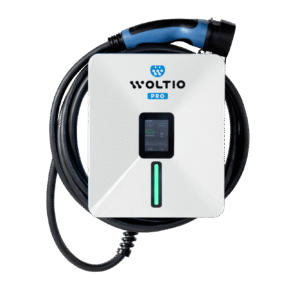
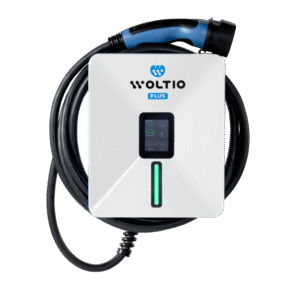
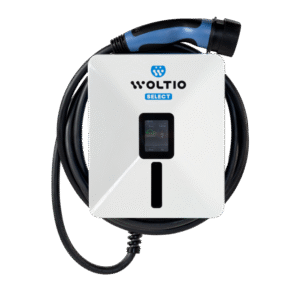
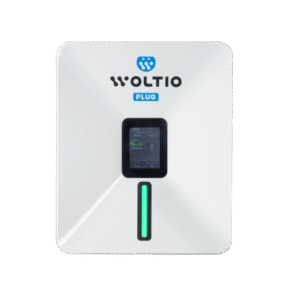
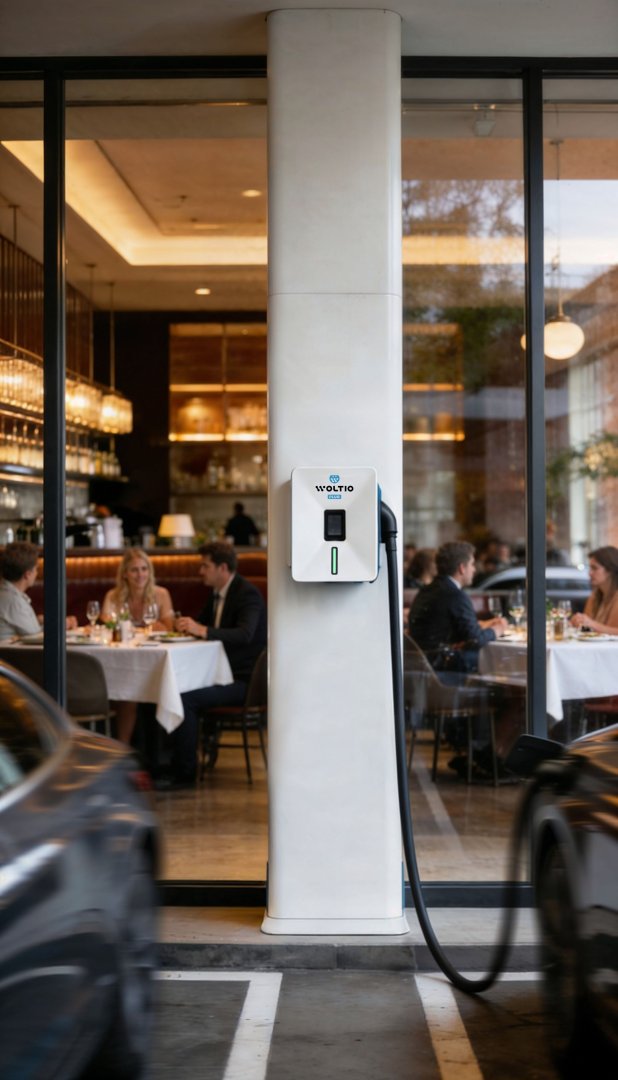
Many modern smart chargers, such as those from WOLTIO, incorporate advanced connectivity to offer more efficient charging management and make integration with different energy control systems easier.
From the user’s point of view, the OCPP protocol works in a relatively simple way. The charger connects to the internet, usually via WiFi, Ethernet, or mobile connection, and establishes communication with a compatible management platform.
From that moment on, both systems constantly exchange information. The charger sends data related to charging status, energy consumption, or possible incidents, while the platform sends commands or configurations to the device.
For example, thanks to this communication, it is possible to:
Check the charger status in real time.
Schedule charging times.
Control several chargers from a single platform.
Manage user permissions.
Obtain energy consumption reports.
Detect errors or incidents remotely.
This system is especially useful when several charging points are operating at the same time. It is also a very interesting tool for companies or communities that need to centralize all energy management.
In addition, OCPP-based communication allows the charger to remain updated and ready for future technological integrations.
Choosing an OCPP-compatible charger offers important advantages in both the short and long term. Although some people only consider the device’s power or design, connectivity can make a major difference over time.
One of the main benefits of the OCPP protocol is the flexibility it provides. A compatible charger is not limited to a single closed ecosystem.
This allows the device to be integrated with different energy management platforms according to the user’s needs. In addition, if the installation is expanded in the future or new charging points are added, adaptation is usually much simpler.
For example, a company that starts with two chargers can expand its infrastructure without having to completely change the management system.
In environments where the number of electric vehicles continues to grow, this scalability is especially important.
It is important to know that there is the option to purchase an OCPP kit to connect a charging station to the Internet via an Ethernet cable, a way to simplify the operation and use of charging bases, and one that helps centralize and streamline payments if you charge for the use of the bases.
Another very relevant advantage is the ability to control all chargers from the same platform.
Thanks to OCPP, administrators can monitor the operation of all devices in real time. This greatly facilitates day-to-day management and improves control over energy consumption.
In business installations or shared community car parks, this function makes it possible to:
Control access.
View usage statistics.
Manage incidents.
Optimize charging schedules.
Configure power limitations.
Centralized management also simplifies maintenance tasks and reduces the time needed to detect possible technical problems.
Closed systems can create significant limitations over time. When a charger only works with a specific manufacturer platform, the user becomes dependent on its compatibility. But the OCPP protocol reduces that dependence because it facilitates interoperability between different technological solutions.
This means the user has more freedom to change management platforms if needed. It also allows new equipment to be integrated or the installation to be adapted to future needs without starting from scratch.
Although virtually any user can benefit from an OCPP-compatible charger, there are situations where this technology is especially recommended.
One of the clearest cases is companies with several electric vehicles. Managing different chargers without a centralized platform can make it much more difficult to control consumption and users.
It is also very useful in homeowners’ associations, where it is usually necessary to supervise different charging points and allocate energy costs correctly.
Vehicle fleets are another common example. In this type of installation, remote control and constant monitoring help optimize charging times and improve operational efficiency.
In addition, the OCPP protocol becomes even more important in installations expected to grow. Choosing compatible smart chargers from the start makes future expansions easier and avoids technical limitations.
Even in private homes, having this technology can be interesting. More and more users are looking to integrate their charger with home automation systems, solar panels, or advanced energy management tools.
Not all OCPP-compatible chargers offer exactly the same possibilities. Before choosing a specific model, it is worth reviewing several important aspects.
One of them is the version of the protocol supported by the device. There are different versions of OCPP, and some offer more advanced features than others.
It is also advisable to check what type of connectivity the charger includes. Connection stability is essential to ensure smooth communication with the management platform.
Another important aspect is ease of integration with mobile applications and external systems. In this regard, solutions such as the WOLTIO app allow you to control the main charging parameters conveniently and easily from your smartphone.
It is also worth assessing the software user experience. An intuitive platform makes daily management much easier and improves the use of all the charger’s smart features.
And it should not be forgotten that it is also important to choose devices manufactured according to quality standards and prepared to adapt to future technological needs. Electric mobility is evolving at a rapid pace, and having a flexible charger that is suitable for working with different software solutions can make a major difference in the long term, especially in terms of compatibility and convenience.