Although many electric car chargers claim to be compatible, the truth is that not all of them are universal, and this can cause problems when using a charging station. That’s why it’s so important to make sure that the charger you’re going to install is universal.
A universal charger is one that is compatible with all types of models and manufacturers. However, the proliferation of these chargers depends on the territory, since, as is always the case in the field of electronics, each continent tends to have its own preferences.
Europe has prioritized the standardization of the Type 2 connector for AC charging, but the European EV fleet has models that require Type 1 connectors, which is why some drivers prefer to have a universal charger, especially if they have more than one vehicle and each one has different charging requirements.
Unlike chargers for other devices, such as cell phones, electric car chargers are not completely universal. This is because there are different types of connectors, power ratings, and communication protocols between the vehicle and the charging point.
Each manufacturer can incorporate a specific charging system into its vehicle, and although progress has been made toward standardization in recent years, there are still significant differences depending on the country, the type of charge, and the car model.
As mentioned above, the European Union has promoted the use of the Type 2 connector as the standard for alternating current (AC) charging, which means that most electric cars sold on the continent use this type of plug. However, there are older or imported models that use other connectors, such as Type 1, which is very common in the United States and Asia.
In the case of fast direct current (DC) charging, the picture is somewhat more complex. Here we find three main systems:
Therefore, although many chargers can be used for different vehicles, not all are compatible with all models. The key is the type of connector and the power supported by both the car and the charging point.
Chargers are classified according to charging speed and the type of electrical current they use. Understanding these differences helps explain why some chargers are compatible with certain vehicles and others are not.
This is the most basic and common way to charge an electric car at home. It is done by connecting the vehicle to a conventional power outlet using a cable with an integrated control unit.
The charging power is usually low (between 2.3 and 3.7 kW), so it can take several hours to complete the charge. This method is useful for charging at night, although it is not the most efficient.
The most common connector for this type of charging is Type 1 or Type 2, depending on the car.
These chargers, known as wallboxes, are designed to be installed in homes, garages, or businesses. They offer power ranging from 3.7 kW to 22 kW, depending on the available electrical installation.
The connection is made directly between the vehicle and the charger using a fixed or removable cable.
Most current electric vehicles use Type 2 for this type of charging, which is the European standard. Some older or imported models may require adapters to use this type of charger.
Fast charging uses direct current (DC) and power ratings ranging from 50 kW to over 350 kW. It is mainly found at public stations or on highways.
The most commonly used connectors are:
Thanks to their high power, these chargers can recover a significant portion of the battery in less than half an hour. However, frequent use can cause more wear and tear on the battery in the long term.
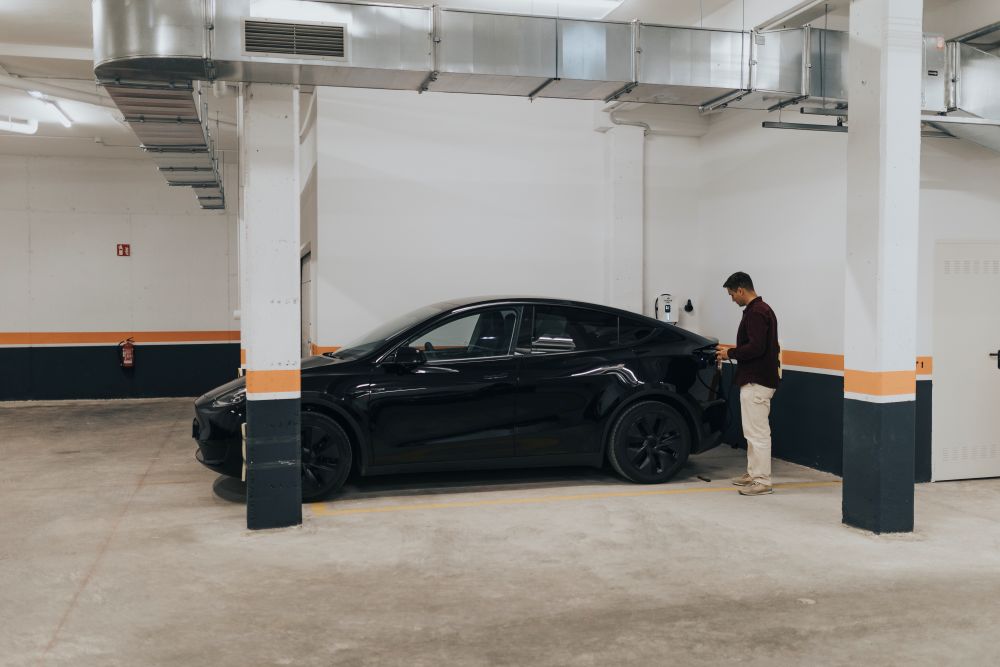
Compatibility between the car and the charger depends mainly on three factors: the type of connector, the charging power, and the communication mode between the two.
The first step is to check what type of plug your vehicle uses. This information can be found in the car manual or on the charging port cover.
The most common types are:
Knowing which connector your car uses will allow you to identify which charging points or home chargers you can use.
The charger must offer a power rating equal to or lower than that which the car can accept. If the charger has more power than the vehicle can handle, there is no danger: the car will simply limit the charge to its maximum level.
For example, if a car supports 7.4 kW and the charger is 11 kW, the car will charge at 7.4 kW. On the other hand, if the charger has less power, the process will be slower.
Modern chargers incorporate a communication system with the vehicle that regulates the flow of energy and ensures safety. If the communication protocol does not match, the car will not start charging.
Therefore, even if two connectors appear to be physically compatible, it is important to ensure that both devices are technically compatible.
In general, most current electric cars and recent chargers are interoperable within the European standard. However, if you have an older or imported vehicle, you may need a specific adapter or charger.
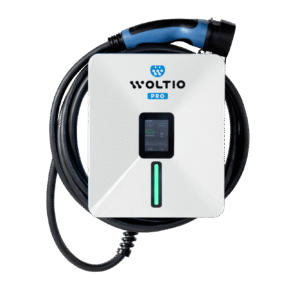
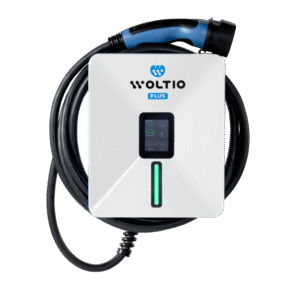
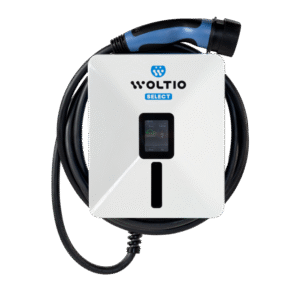
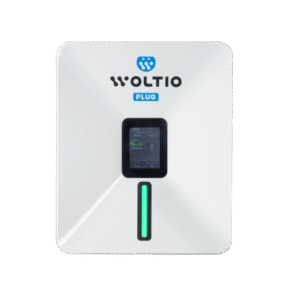
One of the reasons why more and more EV drivers are choosing WOLTIO electric car chargers is that they are fully compatible with all electric and plug-in hybrid vehicle models on the market that use a Type 2 connector, regardless of the manufacturer and model.
WOLTIO chargers have entered the market with the specific aim of offering universal compatibility within the European regulatory framework, which means they can charge cars from different brands, such as Tesla, Renault, Peugeot, BMW, Volkswagen, Kia, Hyundai, and Mercedes-Benz, among many others.
These chargers support different charging powers, allowing them to adapt to different electrical installations. They can be configured for single-phase or three-phase charging and adjusted according to the capacity of the grid and even the vehicle’s battery.
In addition, WOLTIO chargers incorporate intelligent energy management systems that optimize consumption and ensure safety during charging, which is especially useful in homes or businesses where other electrical equipment is operating at the same time.